
Session Summary: Plenary ISMPP EU 2026
Pooja Banerjee
At the 2026 European meeting of the International Society for Medical Publication Professionals (ISMPP EU), one challenge echoed across sessions and side conversations alike: medical communications teams are expected to deliver increasing volumes of content from the same body of evidence; faster, across more formats, and for to more diverse audiences than ever before.
The plenary session “Efficient Adaptation, Consistent Meaning: A Framework for Tailored Scientific Communications” addressed a fundamental question behind this challenge.
How do we adapt scientific content for different audiences, regions, and formats without fragmenting meaning or losing scientific credibility?
The session argued that the answer does not lie in tools, platforms, or tactics, but in story.
Why story matters now
We are operating in an era of fragmented attention, information overload, and accelerated use of AI-generated content. In this environment, the problem is rarely a lack of information. Instead, it is the absence of coherence.
Human beings are wired for narrative. Even in highly technical or scientific contexts, stories help audiences understand relationships, retain information, and build trust. Data presented without narrative structure may be accurate, but it is often difficult to absorb, remember, or apply.

In medical communications, storytelling is not about simplification for its own sake. It is about clarity and continuity, ensuring that scientific meaning remains intact as evidence is communicated through different formats, stakeholders, and geographies.
The master narrative: A stable anchor for scientific meaning
A central concept discussed in the session was the master narrative; the core scientific story that anchors all adaptations.
The master narrative is not a slogan or a headline. It is a carefully constructed articulation of:
- The scientific or clinical problem
- The evidence-based insight
- The relevance to practice, policy, or patients
- The implications that matter most
When clearly defined, the master narrative allows for flexibility without distortion. Language, emphasis, and depth can change to suit the audience, but the underlying meaning, the “soul” of the story remains consistent.
This is what makes story the most valuable and durable asset in medical communications.
The risks of scaling without narrative discipline
As organisations attempt to scale content rapidly, three recurring risks emerge:
- Narrative fragmentation
Different teams interpret and communicate the same evidence in different ways, leading to confusion and misalignment. - Over-reduction of science
In the pursuit of simplicity, nuance is lost, weakening credibility and trust. - Erosion of confidence
Inconsistent messages raise questions among reviewers, clinicians, and internal stakeholders.

These challenges are often mistaken for operational or technological issues. In reality, they are symptoms of insufficient narrative clarity and governance.
One science, many voices: The GLP-1 Example
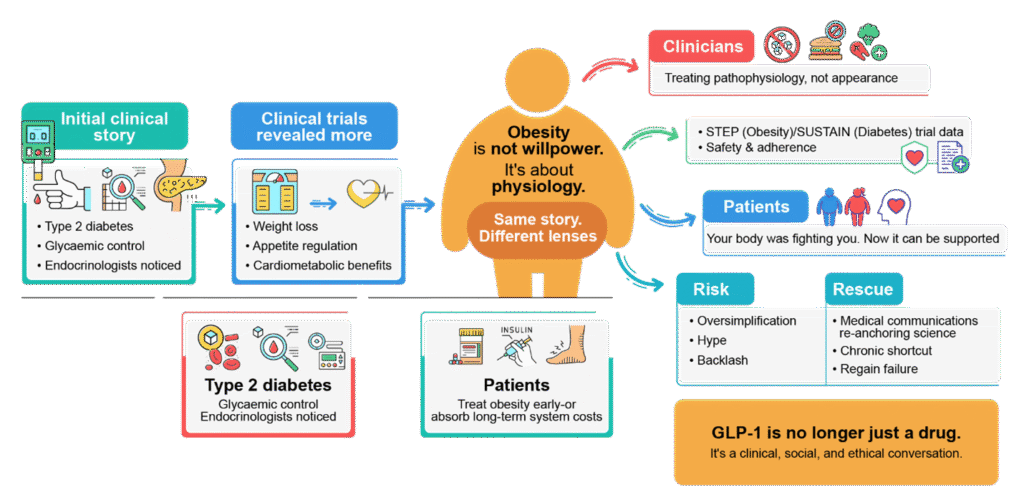
To illustrate how a single scientific story can be successfully adapted without losing integrity, the session examined the evolution of the GLP-1 narrative.
Originally rooted in endocrinology and metabolic research, GLP-1 science expanded into broader discussions about obesity, cardiometabolic risk, public health, and policy. What enabled this expansion was not repetition of data, but disciplined storytelling:
- A clearly articulated core narrative
- Tailored messaging for different audiences
- Regional adaptation with contextual relevance
- Guardrails to protect scientific meaning before and after adaptation
The science did not change. The framing did. And the story held.
Practical takeaways for medical communications teams
Several actionable principles emerged from the discussion:
- Start with the story, not the format
Define the narrative before deciding how or where it will be shared. - Protect the soul of the science
Establish ownership, shared definitions, and clear narrative boundaries. - Adapt to engage, not to dilute
Tailoring should enhance relevance, not compromise meaning. - One core story, many expressions
Flexibility works only when anchored in a stable narrative foundation.
An important shift highlighted during the session was the need to move beyond content production toward shared narrative stewardship, where writers, reviewers, medical teams, and other stakeholders collectively safeguard meaning as science travels.
Story as a long-term advantage
The closing discussion reinforced a simple truth; a well-crafted scientific story is both durable and transferable.
While formats, technologies, and dissemination routes will continue to evolve, the need for coherent, credible storytelling will remain constant. In an increasingly noisy environment, story is what allows evidence to cut through, without losing its integrity.
At Krystelis, this belief continues to guide how we approach scientific communication; by placing story at the centre, enabling efficient adaptation, and ensuring the meaning remains consistent, no matter how far science travels.